akSaray
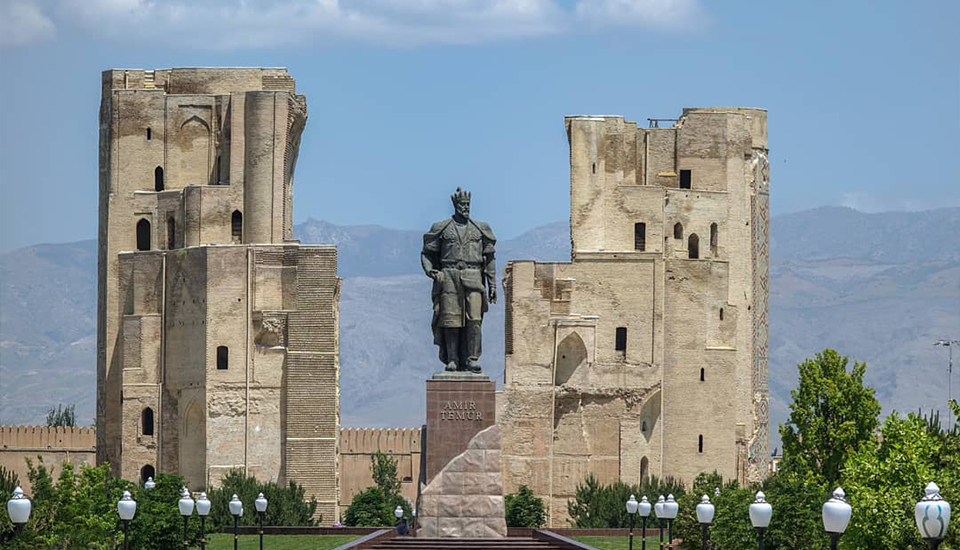
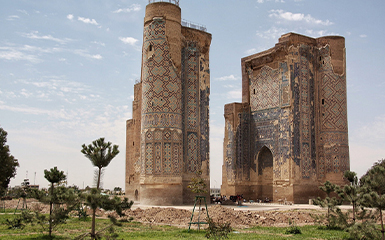
Ak Saray (literally the White Palace) is an archaeological site located in present-day Uzbekistan, in Shahrisabz. Timur was born near Kesh, as Shahrisabz was then called, and wanted to develop the city instead of Samarqand into the capital of his empire. Therefore he had a huge palace built here. Construction of the castle began in 1380 and lasted 24 years until 1404, shortly before Timur's death
The palace is now in ruins. There remains a huge portal, initially 71 meters high, flanked by two cylindrical towers resting on octagonal bases and currently measuring 44 meters. The now collapsed vault, 22.5 meters wide, was the largest in Central Asia. We know of the original descriptive elements, from an account that has survived until our time, by the Spaniard Ruy Gonzáles de Clavijo, appointed as ambassador to Tamerlan in 1403. From this account, it is estimated in particular that behind the portal was located a courtyard with a basin, covered with white flagstones, about 100 meters square, surrounded by richly decorated arcades
The portal was covered with ceramic tile decorations, partially visible today, some reproducing the names of Allah and Muhammed in square Kufic script. The function of this portal has given rise to two interpretations following the two ancient descriptions available to us: according to Clavijo, it was the entrance portal to the palace; according to Babur, according to his work Baburnama, it would be the iwan where Timur held his audiences
The palace has a very long entrance and very high gates, and here, at the entrance, on the right and left sides there were brick arches decorated with tiles lined with different patterns. And under these arches there were, as it were, small rooms without doors, that is, with a floor lined with tiles, and this was done so that people sit there when the lord was in the palace
Immediately beyond these gates were others, and beyond them a large courtyard, paved with white slabs and surrounded by richly decorated galleries; and in the middle of the courtyard there is a large reservoir, and this courtyard is three hundred paces wide, and through it they entered the largest room of the palace, where a very large and high door, trimmed with gold, azure and tiles, very skilful work, led. And above the door in the middle there was a lion [in the background] of the sun, and along the edges exactly the same images. It was the coat of arms of the lord of Samarkand
The impressive dimensions of the palace are characteristic of the political aspect of Timurid architecture of the time: an inscription on the portal, “If you doubt our power, look at our buildings”, was intended to impress foreign visitors
The palace was destroyed in the 16th century by the Emir of Bukhara Abdullah Khan II